General mentor training grant 2025-26
ITT Mentor Training Funding |
Make sure that you claim funding for your school for ITT mentoring
We want to make you aware that additional guidance relating to the DfE Initial Teacher Training (ITT) General Mentor Grant has recently been published (click here). If you host a placement for a trainee teacher, you will be providing mentor expertise. The guidance includes information about how your school can access the service to make a claim for funding to cover the cost of releasing your mentor from their usual duties. You are even eligible if your trainee withdraws from training during the year or if you are offering a shorter placement.
The first claim window for ITT general mentor funding for academic year 2025/26 opened on 27 April 2026. Claim funding for mentor training.
ITT placement schools that have been added to the Register trainee teachers service by their ITT providers should have been on-boarded to the service. Up to two DfE sign-in approver accounts have been on-boarded to the service for each school, and they can add additional users.
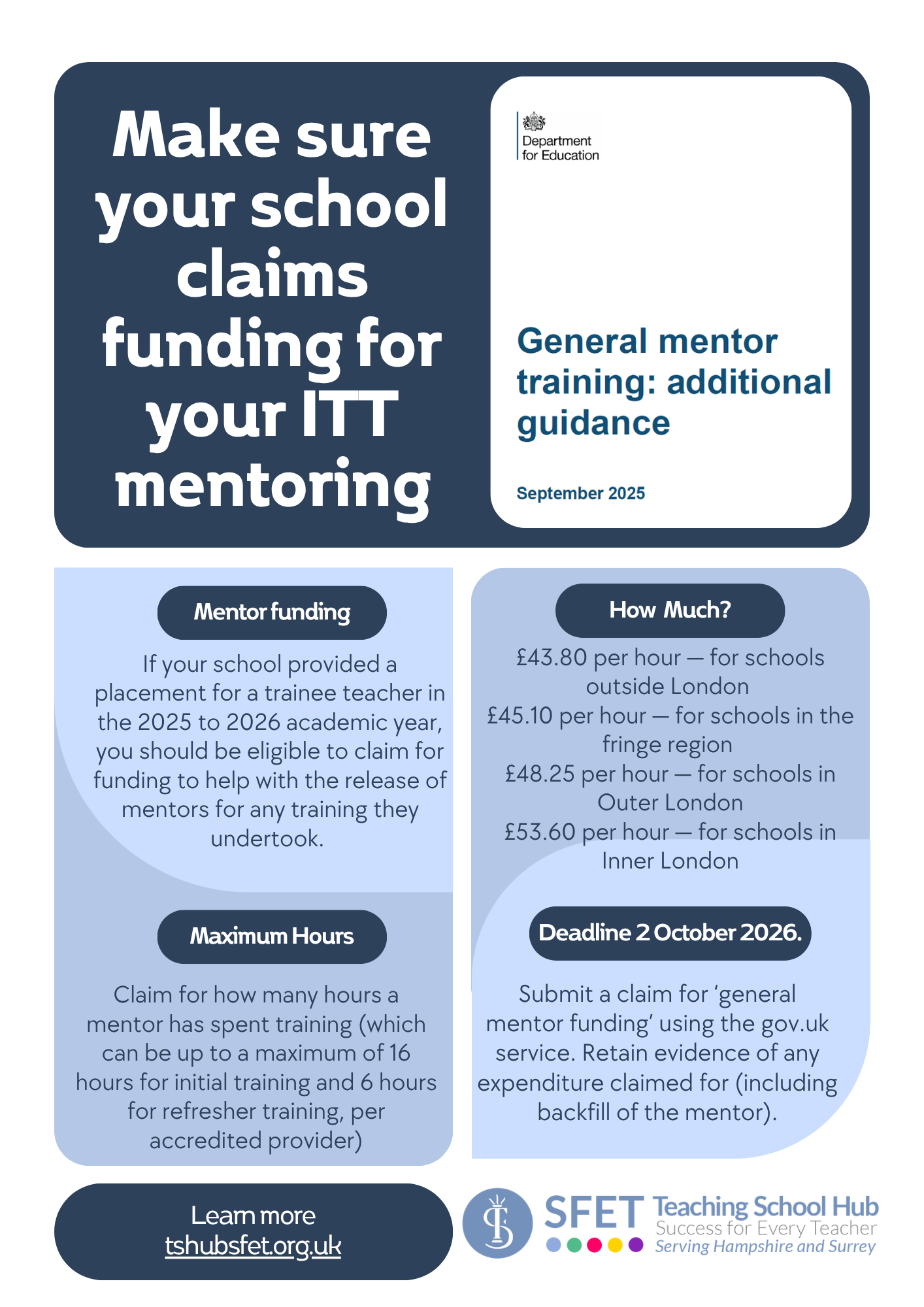
The window for schools to claim general mentor funding is live and closes on 2 October 2026.
Placement schools can claim funding for the time their ITT mentors have spent in training during the 2025 to 2026 academic year.
Schools can claim for the actual hours of training undertaken by the mentor to a maximum of 16 hours.
This funding will help with the cost of teachers being away from the classroom while they train. This could include:
- paying for someone to take over lessons while a teacher is training
- paying for someone to teach if a teacher takes time off in lieu to train
- overtime payment to the teacher, if they are training outside of normal working hours (teacher workload should be carefully considered in such cases)
- paying for any costs that come from reducing a teacher’s other responsibilities so they have time to train
This funding applies to schools that:
- offer placements to ITT trainees, including independent schools and further education organisations
- have mentors working with ITT trainees who started their training at any time between 1 September 2025 and 31 May 2026
Schools can claim for the actual hours of training undertaken by the mentor to a maximum of 16 hours.
How much funding is available to schools?
The amount of funding schools will receive depends on:
- the location of the school, recognising the different costs in different areas of the country
- how many hours a mentor has spent training – this can be up to a maximum of 16 hours of initial training and 6 hours for refresher training, per accredited provider
How much a school can claim per hour?
Schools that host ITT trainees in the academic year 2025 to 2026 can claim:
- £43.80 per hour for schools outside London (the rest of England)
- £45.10 per hour for schools in the fringe region (the area between Outer London and the rest of England)
- £48.25 per hour for schools in Outer London
- £53.60 per hour for schools in Inner London
Schools will be able to claim this funding at the end of the 2025/26 academic year and will be paid in arrears between September 2026 and January 2027.
Check the location of your school in Annex A.
The funding is calculated per hour. For example, if a mentor in a school outside London completed 8 hours of initial training, the school can claim £350.40.
This is calculated at £43.80 per hour x 8 hours of training.
The attachments below contain the key pages relating to the general mentor training grant.
The full document can be read here.
If your school has not been on-boarded
Step 1: if a school has not received an email from DfE inviting them to the service, they should check with their DfE sign-in approvers to see if they’ve received it. If so, they will be able to add additional users.
Step 2: if the school’s DfE sign-in approvers have not received an email from DfE inviting them to the service, they should check with their ITT provider that they have recorded the school on the Register trainee teacher service. Once this is done, schools will be on-boarded to the Claim Funding service monthly, so the school should receive an email within a month of their accredited ITT provider recording them as a placement school.
Mentor Funding FAQs
| Question | Answer |
|---|---|
| What happens to the funding for main mentor training if a trainee withdraws mid-year? Can the mentor still continue with their training to complete the 16 hours if they choose to, even if they don’t have a trainee any more? | Yes, the school, accredited provider and the mentor can decide on whether the mentor completes the training. If the mentor does continue to train, it is expected they should intend to mentor in consequent years, but this will not be a requirement to receive funding. |
| Can second school mentors access the DfE funding for the 16 hours of training even if they are only hosting a second placement (6 weeks)? | All educational settings which hosted an ITT trainee or had arranged to host an ITT trainee (for any length of time) on an ITT course leading to QTS, will be eligible for this funding. |
| What will be the funding arrangement if a trainee withdraws before they start second placement. | Funding can still be claimed, as a trainee had intended to train. |
| As above, are they able to complete the training (funded) if they no longer have a trainee due to withdrawal? | Yes, the school, accredited provider and the mentor can decide whether the mentor completes the training. |
| What happens if a mentor has a long-term absence or leaves mid-year? Do mentors who take over from there need the full 16 hours training entitlement? – at what point is that considered not a feasible option given that much of our training is front-loaded and linked to the trainee curriculum and assessment at each stage? | If a mentor cannot continue mentoring, schools can replace and claim training time for new mentors. The accredited provider, school and the new mentor will need to assess the number of hours of training that is appropriate and feasible for the new mentor. |
| Will guidance be generated to support planning beyond 2026? | The guidance will only cover AY25/26. This is because funding beyond 2025/26 is contingent on approvals from across government and will take place as part of the next Spending Review process. To maximise the likelihood of securing future funding, the Department will require significant evidence to demonstrate the grant’s value for money. |
| Can a job-share pair of mentors, both working with the same trainee, both claim the full 16 hours of funding? | Schools must ensure a trainee has one dedicated mentor during their placement. Other teachers may support elements of the trainee’s placement, but schools can only claim funding for the training time of the trainee’s dedicated mentor. However, if the mentor role is taken on by staff on a jobshare, then the school can claim the full 16 hours for both. |
| Can further education settings access this funding? | Yes, if they meet the criteria detailed in this guidance - Initial teacher training reform funding guidance - GOV.UK (www.gov.uk) |
| Can early years settings access this funding? | Yes, if they meet the criteria detailed in this guidance - Initial teacher training reform funding guidance - GOV.UK (www.gov.uk) |
| Is there a minimum duration for placements? | There is no minimum placement duration for an organisation to submit a claim for general mentor funding. |
NIoT Developing Support Strategies for ITE Mentors: Insights from Current Practices
 Developing Support Strategies for ITE Mentors: Insights from Current Practices
Mentors play a key role in supporting Initial teacher education (ITE) trainees, providing support and guidance to maximise successful induction into the teaching profession, whilst encouraging the development of quality teaching practices. A supportive school environment is crucial in nurturing the partnership between mentor and mentee. However, whilst mentors are often part of a wider support network focused on the trainee, their own needs may be overlooked.
Recent Initial Teacher Training (ITT) reforms in England place increased emphasis on the expectations of school-based ITT mentors which means we need to learn more about how schools can best support their mentors, and what impact this support has on mentors’ practice and wellbeing. Using a mixed-methods design, this study aims to understand the current situation of school support for ITE mentors, the perceived needs and challenges faced by mentors, and how schools may be able to better support mentors. The intended outcome of the study is to develop a support package that will enhance school support for ITE mentors in future practice.
You can read the full report here.
NIoT Mentoring and coaching trainee and early career teachers
 Mentoring and coaching trainee and early career teachers
All trainee and early-career teachers have mentors. Under the new Early Career Framework, these mentors play a more important role than ever. But the way mentors are chosen and the support they offer varies widely – there is considerable ambiguity about what good mentoring actually involves.
For example, we know that many schools are struggling to identify appropriate mentors and to provide them with sufficient time and support. Within this context there is a need for more guidance.
Our research on teacher mentoring explores how mentoring programmes can best deliver the outcomes we care about – teacher wellbeing, retention, improved teaching practice and pupil attainment. It's also informed by research with current teachers, and by an expert panel including teaching leaders. We will put its findings into practice in our own mentoring programmes and then communicate them to the wider sector.
You can read the full report here.